
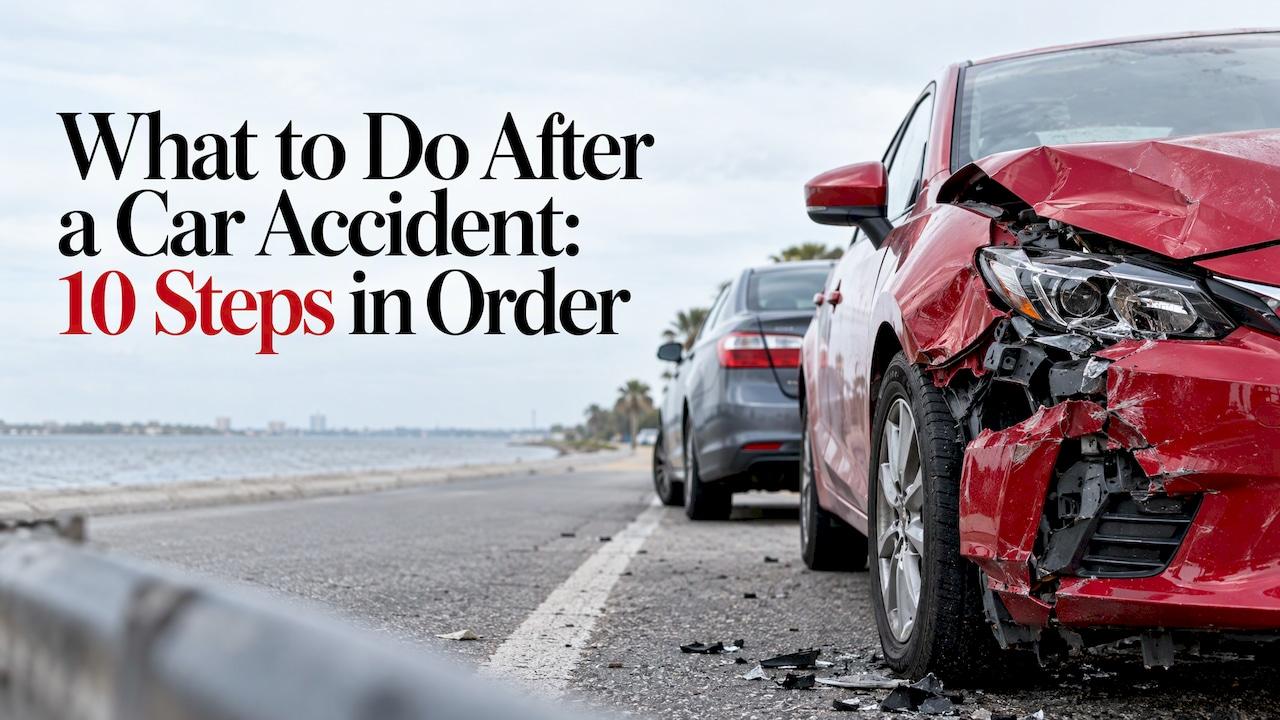
After a car accident, check everyone for injuries, call 911 if anyone is hurt, move the vehicles out of traffic if they can be driven, and stay at the scene. Then photograph everything, swap information without admitting fault, report the crash to the police and your insurer, and choose the body shop yourself. This guide walks through each step in the order you will need it, with the Florida rules that apply here in Escambia County.
TL;DR
- Safety first: check yourself and your passengers, call 911 for any injury, turn on hazard lights and never leave the scene.
- In Florida, you must call law enforcement if the crash involves an injury, a hit and run, a tow, or apparent damage of at least $500.
- Take photos, collect names, plates and insurance details, and stay factual. Don't apologize or argue about who was at fault.
- Report the claim to your insurer quickly, and see a doctor within 14 days if you may be hurt. Florida's PIP benefits depend on it.
- You choose the repair shop. Your insurer may suggest one, but it cannot make the decision for you.
Table of Contents
- Step 1: Check for injuries and make the scene safe
- Step 2: Call 911 and decide whether police must come
- Step 3: Collect information without admitting fault
- Step 4: Document the scene
- Step 5: Handling a minor accident or fender bender
- Step 6: See a doctor, even if you feel fine
- Step 7: Report the claim to your insurer
- Step 8: Know what a claim can do to your rates
- Step 9: Choose your body shop
- Step 10: Keep a file until the car is back
- Mistakes that cost drivers money
- We handle the claim, you get your car back
- FAQ
- Sources
Step 1: Check for injuries and make the scene safe
Your first job is making sure everyone is okay. AAA's guide says to stay calm, check yourself and your passengers, call 911 if anyone needs medical attention, and check on the other driver as well.
State Farm adds two details worth remembering: don't move anyone who is injured unless there is immediate danger, such as a fire, and keep your hazard lights on.
If everyone is safe and the cars can be driven, move them to the shoulder or a parking lot. Wisconsin's transportation department makes the same point: only drive to a safe spot if no one is hurt. If the road is unsafe and you can't get clear, stay buckled in with your hazards on and let the police come to you.

On I-10, I-110 or the Pensacola Bay Bridge, a stopped car is a hazard. Getting out and standing between lanes is the most dangerous thing you can do. Move to the far side of a guardrail if you must leave the vehicle.
Step 2: Call 911 and decide whether police must come
In Florida this is not optional in many cases. The state highway safety department says you must notify law enforcement and stay at the scene when a crash involves:
- an injury or a fatality
- a hit and run or a suspected DUI
- a vehicle that needs a wrecker
- a commercial motor vehicle
- apparent damage of at least $500
Modern bumpers and sensors mean $500 is a low bar. A cracked bumper cover alone can pass it. Treat nearly every crash as reportable.
The habit is a good one everywhere. An AARP expert advises calling the police whether or not you think you need them, because your insurer may ask for a report. Nolo notes that many states set a low damage threshold for requiring a police call.
When the officer arrives, give your license and insurance information and tell them exactly what happened. Stick to facts, and ask for the officer's name, badge number and the report number. Progressive's guide recommends the same.
Only minor crashes with no injury, no tow and under the threshold can be self-reported. Florida's agency offers a driver report form you can mail in for those cases. Crash reports can take up to 10 days to become available, and the agency charges $10.00 per report.
Step 3: Collect information without admitting fault
You need the same details from every driver involved. The California Department of Insurance lists them:
- names, addresses, phone numbers and driver's license numbers
- license plates and VINs
- passenger and witness contact information
The Texas Department of Insurance suggests a faster way: take a picture of the other driver's insurance card and license. Record the insurer and policy number exactly as printed.
Keep the conversation short. Liberty Mutual advises against admitting fault, making accusations or apologizing, since in some states and situations that could be read as an admission of liability. The Oklahoma Insurance Department puts the reason simply: the adjuster, not you, determines negligence.
You can still be kind. Ask whether the other driver is okay. Just don't discuss who caused it.
Step 4: Document the scene
Photos win arguments later. Take more than you think you need, from several angles:
- Damage on all vehicles, close up and wide.
- License plates of every car.
- The whole intersection or stretch of road, including signs, signals and skid marks.
- Road conditions, weather and anything blocking sight lines.
- Any debris, and the position of the cars before they are moved, if it is safe to take the picture.
The Texas agency also suggests writing down the location, time, weather and what happened while your memory is fresh. A note on your phone is fine.
If a witness stops, get a name and number. The Illinois Department of Insurance also lists witness contact details among the basics.
Step 5: Handling a minor accident or fender bender
A small dent does not change the order of operations. Check for injuries, move out of traffic, photograph, exchange details. The difference is that people are tempted to say "we'll handle it ourselves."
Don't. The North Carolina Department of Insurance warns against agreeing to forget about an accident, because hidden damage, unknown injuries or a later lawsuit can surface afterward. A bumper that looks fine can hide cracked reinforcement bars, broken clips or sensors that no longer aim correctly.
If damage is under $500 and nobody is hurt, you may be able to self-report in Florida. You should still photograph the damage and get a written estimate from a body shop.
Step 6: See a doctor, even if you feel fine
Adrenaline hides pain. Soreness often shows up the next morning. Florida adds a deadline: under the state's PIP rule, you generally need to get initial medical care within 14 days of the crash to use personal injury protection benefits. Ask your insurer or a Florida attorney how it applies to your policy.
Keep every medical record and bill. The Texas insurance department says to save medical records and bills if you see a doctor.
Step 7: Report the claim to your insurer
Call your insurance company or agent the same day if you can. The Illinois Department of Insurance says to start the claim while details are fresh and to have the police report number, your policy information and your own notes ready.
Ask for these in the first call:
- the adjuster's name and direct number
- whose coverage will pay for the vehicle damage, a rental car and medical costs
- what the next step is and when
Write down the date, time and the name of every person you speak with. Illinois recommends keeping notes on every conversation with insurers, adjusters and shops.
This is the stage many drivers find most draining: calls, forms, callbacks. We take that off your plate, as the Promo section below explains.
Step 8: Know what a claim can do to your rates
The worry is real, so here are the facts. In Texas, regulators say insurers can raise premiums for most paid claims but can't charge you more for claims they didn't pay.
A not-at-fault crash is less likely to raise rates, but GEICO says it is no guarantee, and it depends on your state's rules. Travelers says that when a claim affects a premium, the change may last about 3 to 5 years.
For at-fault crashes, NerdWallet's 2026 analysis found full coverage rates rise an average of 49% a year, or $1,157 more on average.
Still, reporting is the safer path. A former insurance agent quoted by AARP says to report nearly every accident, because a late or improper report can lead to a denied claim. Your insurer can tell you how Florida rules apply to your policy.
Step 9: Choose your body shop
This is where many drivers feel pushed. Your insurer may hand you a list. The Texas Department of Insurance is clear: you can take your car to any shop you choose. North Carolina's regulator says the insurer pays the amount payable under your policy whether or not you use the recommended shop. Check Florida's rules with your insurer or the state's insurance consumer line.
Here is how the process usually goes:
- An adjuster or appraiser inspects the damage and writes an estimate.
- The shop reviews it. If it finds more damage once panels come off, it sends a supplement to the insurer for approval.
- You sign the authorization once you are satisfied with the estimate and the shop.
That sequence is described by the California Department of Insurance. Read any agreement the shop gives you before you leave the car.
Delays happen. Washington's insurance commissioner notes that repair delays have risen nationwide because of parts and staffing shortages, and suggests picking up your vehicle promptly once it's done to avoid storage fees.
What to look for in a shop:
| What you need | Why it matters |
|---|---|
| Repairs to factory specifications | Safety systems and panel gaps depend on it |
| Color matching | A repaint should be hard to spot in daylight |
| Direct work with your adjuster | Fewer calls for you |
| Clear written estimate | No surprises at pickup |
| Help with a rental car | You keep moving during repairs |
Our collision repair services cover each of these, and we handle frame work, bumpers, paint and dent repair under one roof.
Step 10: Keep a file until the car is back
Create one folder, paper or digital, with:
- the police report number and a copy of the report
- photos and your scene notes
- the claim number and adjuster contact
- estimates, supplements and the final invoice
- medical bills and rental receipts
If the other driver fled, or has no insurance, tell the police and your insurer right away. The Texas guidance lists both situations as times to call the police.
Mistakes that cost drivers money
- Leaving the scene. AAA is plain: never leave, even after a small bump.
- Skipping the report. In Florida, apparent damage of $500 or more already triggers the requirement.
- Posting about it online. Keep details between you, the police and your insurer.
- Signing before you read. Review any release or repair agreement first.
- Waiting on the doctor. Remember the 14-day window.
Our perspective
After more than three decades repairing cars in Escambia County, we've watched the same thing happen. The crash itself is over in a second. The weeks of phone calls with adjusters are what wear people out.
That's why we built our shop around the claim, not only the repair. We work directly with your insurer, coordinate your rental car and talk to the adjuster so you don't have to. Insured repairs also come with an instant $500 discount.
Our goal is factory-spec repair and paint so close to the original that you stop thinking about the accident. You have the right to choose where your car goes. We'd be glad for you to choose a family-owned shop that has been doing this since 1988.
the author
We handle the claim, you get your car back
If your car needs work after a crash, call us from the roadside or from home. We manage the paperwork with your insurer, coordinate towing and a rental car, and repair your vehicle to factory specs. Our insurance claim assistance page explains how it works, and insured repairs get an instant $500 discount.

Need wheels in the meantime? See our rental car coordination. Browse everything we repair on our services page. We serve Pensacola, Gulf Breeze, Navarre, Milton, Pace, Cantonment and Perdido Key. For a local checklist, see our Pensacola after-accident guide.
FAQ
Should I file a claim if the accident wasn't my fault?
Usually yes. Reporting protects you if the other driver disputes the facts or has no insurance. Not-at-fault claims are less likely to raise rates, though GEICO notes there's no guarantee. Ask your insurer how it treats them in Florida.
Do I have to call the police for a small accident in Florida?
Yes if there is an injury, a tow, a hit and run, a DUI suspicion or apparent damage of at least $500. Florida's highway safety department lists these triggers. Because $500 is easy to reach, calling is the safe default.
Can my insurance company make me use its body shop?
No. Regulators in Texas and North Carolina state that you can select the shop. Confirm Florida specifics with your insurer.
How soon should I see a doctor?
As soon as possible, even if you feel fine. Florida's PIP rule generally requires initial care within 14 days to access benefits.
What should I never say at the scene?
Avoid admitting fault, accusing anyone or apologizing. Liberty Mutual explains these can be treated as admissions of liability. Share facts only.
Sources
- AAA: 6 Things to Do After a Car Accident
- State Farm: What To Do After a Car Accident
- Wisconsin Department of Transportation: Safe driving
- Florida Highway Safety and Motor Vehicles: Traffic Crash Reports
- AARP: Safe-Driving Checklist
- Nolo: Report a Car Accident to the Police?
- Progressive: What to Do After a Car Accident
- California Department of Insurance: So You've Had an Accident
- Texas Department of Insurance: Were you in a wreck?
- Liberty Mutual: What to do after a car accident
- Oklahoma Insurance Department: How to File a Claim
- Illinois Department of Insurance: What To Do After an Accident
- North Carolina Department of Insurance: After an Accident
- Florida PIP 14-Day Rule explained
- Texas Department of Insurance: Will my premium go up if I file a claim?
- GEICO: How much does auto insurance go up after a claim?
- Travelers: Should I File a Claim?
- NerdWallet: How much insurance goes up after an accident
- AARP: When to File an Insurance Claim
- Washington Office of the Insurance Commissioner: Filing an auto insurance claim
- Texas Department of Transportation: Tips to avoid collisions